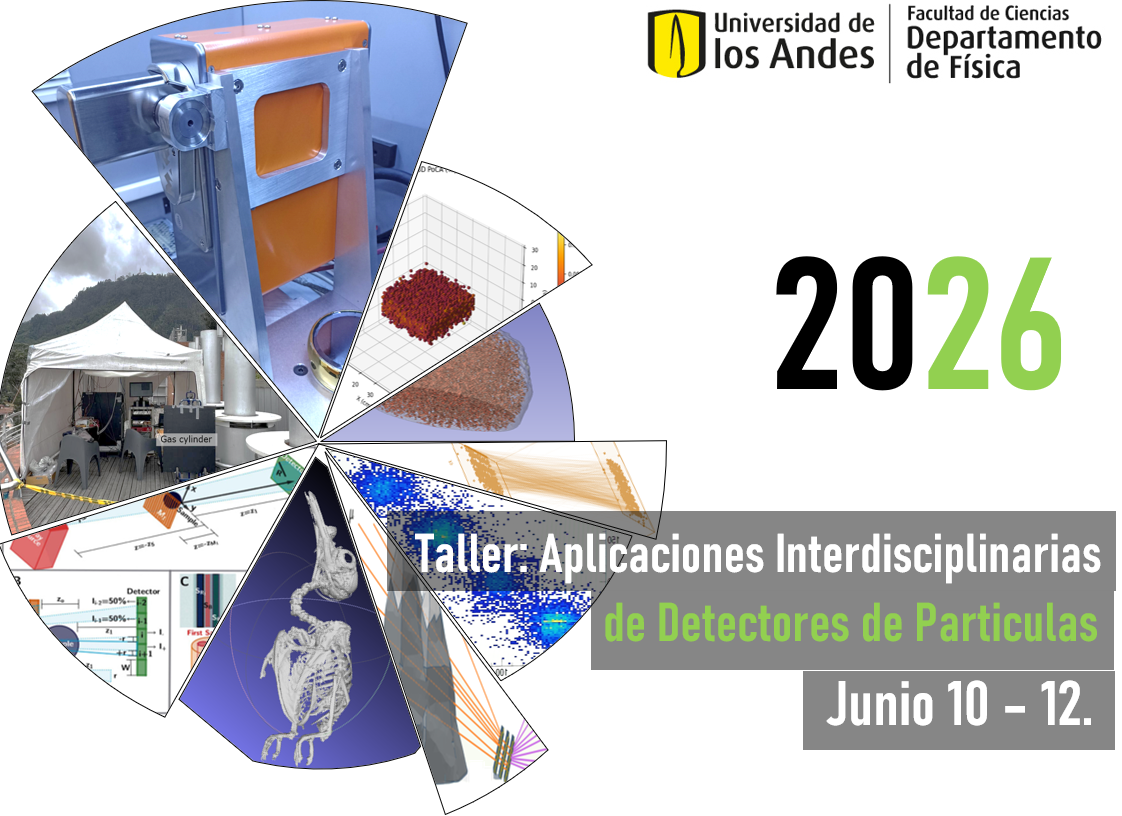
TALLER: APLICACIONES INTERDISCIPLINARIAS DE DETECTORES DE PARTÍCULAS

America/Bogota
Universidad de los Andes

Universidad de los Andes

Conferencias / Lectures: Dirección / Address: Carrera 1 No. 19 - 20 Edificio / Building: Rgd. Salón / Room: Rgd 110 - 11 Sesiones Computacionales / Hands On Sessions: Dirección/Address: T.B.D Edificio/Building: T.B.D Salón/Room: T.B.D
Jesus Bermudez (Analista de Laboratorio) , Carlos Avila (Universidad de los Andes) , Andres Florez
Description


El TALLER: APLICACIONES INTERDISCIPLINARIAS DE DETECTORES DE PARTÍCULAS tiene como objetivo presentar la aplicación de diferentes tecnologías de detectores y técnicas experimentales más allá de la investigación fundamental en física de partículas. Estas aplicaciones abarcan campos como la medicina, la geología y la ingeniería.


Temas principales:

  • Aplicaciones de técnicas de vanguardia en imágenes de Rayos X por contraste de fase.
  • Detectores de Rayos X espectrales foto-contadores y sus aplicaciones.
  • Simulación de Absorción y Refracción de Rayos X en Python y GEANT4 (G4).
  • Detección de trayectorias de Muones cósmicos y sus aplicaciones.
  • Simulación de sistemas de detección de Muones cósmicos en GEANT4 (G4).


Modalidad:

El taller será presencial, y tendrá lugar en las instalaciones de la Universidad de los Andes. El taller tendrá una duración de tres días y consistirá en charlas magistrales, demostraciones interactivas y presentaciones cortas. Algunas charlas de algunos conferencistas de fuera de Bogotá serán virtuales.


Idioma Oficial:

El idioma oficial del taller es Español. La mayoría de las conferencias serán impartidas en español, con diapositivas en español  o inglés, de acuerdo a la conveniencia de cada conferencista.


Valor de Inscripción:

La inscripción al taller es gratuita.


Fechas Importantes:

  • Apertura de Inscripciones y Envío de Resúmenes: Lunes 20 de Abril de 2026
  • Finalización de Envío de Resúmenes: Viernes 15 de Mayo de 2026.
  • Finalización de Inscripciones: Viernes 25 de Mayo de 2026.


Financiación:

Solo se cuenta con financiación para el pasaje aéreo de algunas charlas seleccionadas de estudiantes de fuera de Bogotá.


Comité Organizador:

  • Jesús Bermúdez.
  • Prof. Carlos Ávila.
  • Prof. Andres Florez.


Patrocinadores:

Universidad de los Andes

    • 09:00 10:00
      Day #3: Morning Lectures - Session 1
    • 10:00 10:30
      Coffee Break 30m
    • 10:30 11:30
      Day #3: Morning Lectures - Session 2
      • 10:30
        Cámaras Compton para localización de fuentes de radiación [Conferencia Virtual] 30m
        Speaker: Maria Laura Perez Lara (University College London (UCL))
      • 11:00
        Rejillas de Difración para Contraste de Fase por Iluminación de Borde 30m
        Speaker: David Jurado Romero (Universidad de los andes)
    • 11:30 14:00
      Lunch Break 2h 30m
    • 14:00 15:00
      Day #3: Afternoon Lectures - Session 1
    • 15:00 15:30
      Coffee Break 30m
    • 15:30 16:30
      Day #3: Afternoon Lectures - Session 2: Day #3: Afternoon Lectures - Session 2 - Student Talks
      • 15:30
        Monte Carlo Simulation of a Plastic Scintillator Detector with Photomultiplier Tube 30m

        Radiation detectors based on plastic scintillators coupled to photomultiplier tubes (PMTs) are widely used in nuclear physics, radiation security, and nuclear medicine. However, the final electrical signal exhibits inherent statistical fluctuations that limit the detector's energy resolution. This work presents a comprehensive Monte Carlo simulation implemented in Python that models the entire detection chain, from scintillation photon generation to the formation of the electrical pulse at the PMT anode.

        The simulation incorporates: (i) photon generation following a Poisson distribution with a mean of 10,000 photons per MeV of deposited energy, (ii) isotropic emission from random positions within a 20×10×5 mm³ rectangular volume, (iii) light trapping via total internal reflection considering a refractive index of 1.58 (plastic) and a critical angle of 39.3°, (iv) photon-to-electron conversion at the photocathode with 25% quantum efficiency modeled as a binomial process, (v) electron multiplication across 10 dynode stages with a total gain of 4^10 ≈ 10⁶, and (vi) temporal pulse shaping using a double-exponential function with characteristic rise time (τ_r = 2 ns) and decay time (τ_d = 30 ns).

        Results show that only 11-15% of generated photons are effectively trapped and contribute to the signal, amplifying the Poisson noise beyond naive expectations. The simulated energy resolution follows the theoretical trend ∝ 1/√E, achieving 8.5% at 1 MeV, consistent with experimental data reported in the literature for commercial plastic scintillators.

        Scintillation detector, photomultiplier tube, Monte Carlo simulation, Poisson statistics, total internal reflection, energy resolution.

        Speaker: Ana María Jativa Gonzalez (Universidad del valle)
      • 16:00
        Detection of thermal neutrons and its applications 30m

        Thermal neutron detection plays a key role in fields such as medical physics, materials science, and nuclear engineering. This work presents a simulation-based study of a thermal neutron detection system using the Geant4 toolkit alongside a proposed experimental setup. The system consists of an Americium-Beryllium (AmBe) source, a paraffin block for neutron thermalization, and a boron-doped graphene film as the neutron converter. Detection relies on measuring the characteristic gamma produced by neutron capture in boron-10, using a BGO scintillator crystal coupled with a SiPM sensor. Monte Carlo simulations focus on system efficiency, paraffin geometry optimization, and signal-to-noise ratio. This design explores boron-doped graphene as a lightweight and efficient converter, offering a promising alternative for the development of compact thermal neutron detectors.

        Speaker: Luis Ricardo Beltran Garcia (Universidad Antonio Nariño)
    • 16:30 16:45
      Cierre del Evento